
Three Wonderful Low Voltage Power Cable Hacks

 Gino
Gino
본문
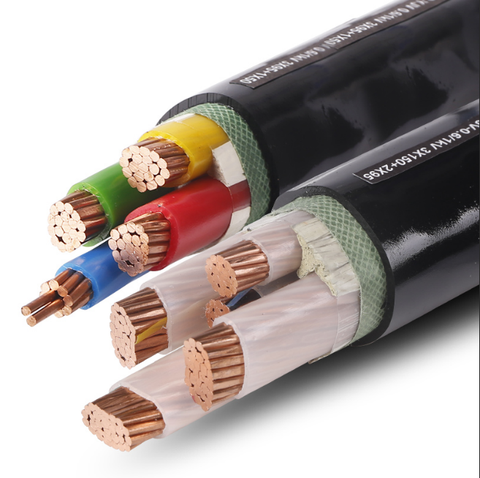 As more insulators are added, every section makes contact with the subsequent, and a rectangular waveguide is formed. Figure 3-19 reveals a bit of a two-wire transmission line supported on two insulators. The insulation behaves as the dielectric of a capacitor formed by the 2 wires of the transmission line. The dielectric in waveguides is air, which has a much lower dielectric loss than typical insulating supplies. The upper cost of XLPE cables is because of the extra advanced manufacturing course of and the superior supplies used, which give better thermal and electrical performance. However, these losses are still decrease than the losses associated with most other strong dielectric materials. DIELECTRIC LOSSES are also decrease in waveguides than in two-wire and coaxial transmission strains. Also, the inside surfaces of waveguides are often plated with silver or gold to scale back pores and skin impact losses. The rigid coaxial line consists of a central, insulated wire (interior conductor) mounted inside a tubular outer conductor.
A low impedance insulator would obviously short-circuit the line to floor, and this is what happens at very high frequencies. The spacers are made from Pyrex, polystyrene, or some other material that has good insulating characteristics and low dielectric losses at excessive frequencies. Ordinary insulators show the traits of the dielectric of a capacitor formed by the wire and ground. Early attempts at gaining flexibility concerned using rubber insulators between the 2 conductors. The lower frequency range of any system utilizing waveguides is proscribed by the physical dimensions of the waveguides. This permits the waveguide to handle a small range of frequencies each above and under the operating frequency. Polyethylene plastic is a solid substance that remains flexible over a wide range of temperatures. However, plated copper busbars, which don't lose contact strain over time, guarantee that there is always contact even in the most severe working situations; therefore, lengthy-time period reliability. With three plants and over 3,000 workers, we achieved RMB 9.7 billion in sales in 2020. Our advanced equipment contains copper drawing traces, 500kV VCV traces, stranding machines, and the SIKORA X-RAY 8000 eccentricity meter.
This is a useful gizmo for security installers to use in planning the perfect energy cable sizes to use when installing CCTV cameras and other low voltage tools. The loudspeaker to which I related the equipment very quietly hums at 50 Hz. Figure 3-18.-Comparison of spacing in coaxial cable and a circular waveguide. This line is basically the identical as the two-wire open line besides that uniform spacing is assured by embedding the 2 wires in a low-loss dielectric, normally polyethylene. The chief benefit of the inflexible line is its ability to attenuate radiation losses. Power-handling functionality is another advantage of waveguides. For instance, the massive floor space of waveguides vastly reduces COPPER (I2R) LOSSES. The voltage potential of the standing waves on the factors of greatest magnitude can grow to be large sufficient to interrupt down the insulation between transmission line conductors. Standing waves are stationary and happen when a part of the vitality traveling down the line is mirrored by an impedance mismatch with the load. Flexible coaxial lines (fig. 3-14) are made with an inner conductor that consists of flexible wire insulated from the outer conductor by a stable, steady insulating material. The magnetic subject in a waveguide is made up of magnetic traces of drive which are brought on by current movement by means of the conductive materials of the waveguide.
This breakdown is normally brought on by stationary voltage spikes or "nodes," that are attributable to standing waves. Standing waves in waveguides trigger arcing, which decreases the effectivity of power switch and may severely damage the waveguide. These fields cause an impedance mismatch which, in turn, causes the development of standing waves and a drastic loss in effectivity. A voltage potential across the two wires causes heating of the dielectric and leads to a energy loss. It isn't used for transmitting excessive frequency because of the high dielectric losses that occur within the rubber insulation. The SHIELDED PAIR, shown in determine 3-12, consists of parallel conductors separated from each other and surrounded by a strong dielectric. Another type of parallel line is the 2-WIRE RIBBON (TWIN LEAD) LINE, illustrated in figure 3-10. The sort of transmission line is commonly used to attach a tv receiving antenna to a house television set. Figure 3-21.-Metallic insulator on every facet of a two-wire line. Figure 3-21 shows several metallic insulators on each side of a two-wire transmission line.
In case you loved this short article and also you wish to receive more information concerning low voltage power cable kindly stop by our own web-site.
댓글목록0
댓글 포인트 안내