
More on Control Cable

 Shelli
본문
 1. Dedicated softened travel path. Conduit is the sleeve that provides the devoted travel path for the control cable core facilitating the routing of management cables in intricate non-linear applications. If, for instance, a motor is operated with a nominal voltage of 230V, there is no such thing as a reason why a control cable cannot be used instead of a motor cable for the power supply. If a motor is supplied via a typical household socket, there isn't a reason why a control cable shouldn't be used as a substitute of a motor cable. There are different types of cables which are manufactured for very totally different functions. However, motor cables are more expensive and thicker than control cables because of the more complex core insulation. Although management and motor cables show some parallels, they are used for various functions. As well as, the use in different voltage courses and also the varying cross section show the necessity of both cable varieties available on the market. Since in many areas a voltage class of 300/500V is completely enough, the control cable is used extra usually. This can be the more price-effective various. In most cases, management cables are solely supplied up to a cross-part of 6mm². However, motor cables with a cross section of 50mm² and more aren't unusual in bigger programs.
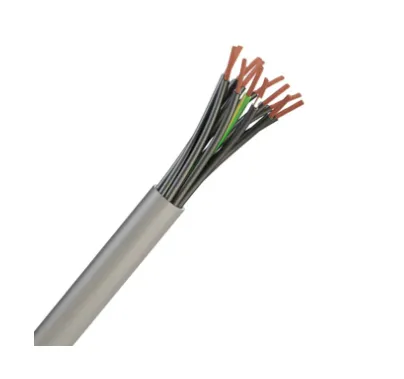 That is stronger with a motor cable than with a control cable despite the identical conductor cross part. Furthermore, motor cables are only accessible from a conductor cross part of 0.75mm². A control cable however is already out there with a cross part of 0.25mm². Differences will also be discovered in the higher restrict of the cross section. Today we make clear the question: what is the difference between a control cable and a motor cable? Conduits include the next subassemblies: a liner (by means of which the core cable runs), a wrap (supplies the flexibleness and safety to the cable assembly), and a jacket (act as a sealing layer in opposition to external surroundings), as shown in the determine under. The conduits for these cables might be of the next three types, and their selection is dictated primarily by the appliance surroundings. The number of bulkhead fittings, core fittings, end fittings, and intermittent transmission fittings relies on the application (Push-Pull, Pull-Pull), the length of the cable, and the trail that the control cable is routed via.
Based on the person necessities, these fittings will be made custom to the application. Please check with the Bergen cables catalog (Bulkhead Fittings, Core Fittings) for extra data. Control techniques, on the other hand, are often far more advanced and subsequently require extra cores to transmit the varied alerts to the appropriate areas. While motor cables are usually supplied with four cores (L1, L2, L3, PE) or as single core, a control cable typically consists of many extra cores. The motor cable with its voltage class of 600/1000V is required if the motor pace is controlled by a frequency converter and voltage peaks occur as a result of pulse width modulation. Since in lots of areas a voltage class of 300V/500V is completely ample, both cable types are justified. They are sometimes not needed. Control cables are categorized by virtue of their mechanical action, i.e. PUSH-PULL and PULL-PULL Cable. In considered one of our final articles we took a better look at the servo cable and the motor cable.
What is the distinction between a control cable and a motor cable? We'd also be happy to advise you personally and find the best cable on your application. Contact us immediately to talk about your specific software. Control cables are mechanic movement transmission cables used to relay the required sign/motion from the operator to the specific management point. These a number of and diversified requirements necessitate the manufacturing of control cables from a vast number of materials and parts and require various manufacturing capabilities to produce the bespoke custom-made cables suited to particular applications. To grasp the control cables manufacturing and consumer selection, it’s necessary to look at the sub-assemblies of the Control cables. As an business leader in manufacturing management cables, Bergen Cable has the capabilities to supply management cables suited to a various range of applications. Bergen Cable manufactures management cables enriched with over 75 years of Bergen Cable’s expertise in wire rope and cables meeting. The control cable returns to its impartial/original place by spring actuation. The primary difference between a management and a motor cable lies in the voltage class. The requirement for a motor cable is always the identical. As a result, the core insulation achieves a better capability, which in turn provides the cable the higher voltage class.
댓글목록0
댓글 포인트 안내